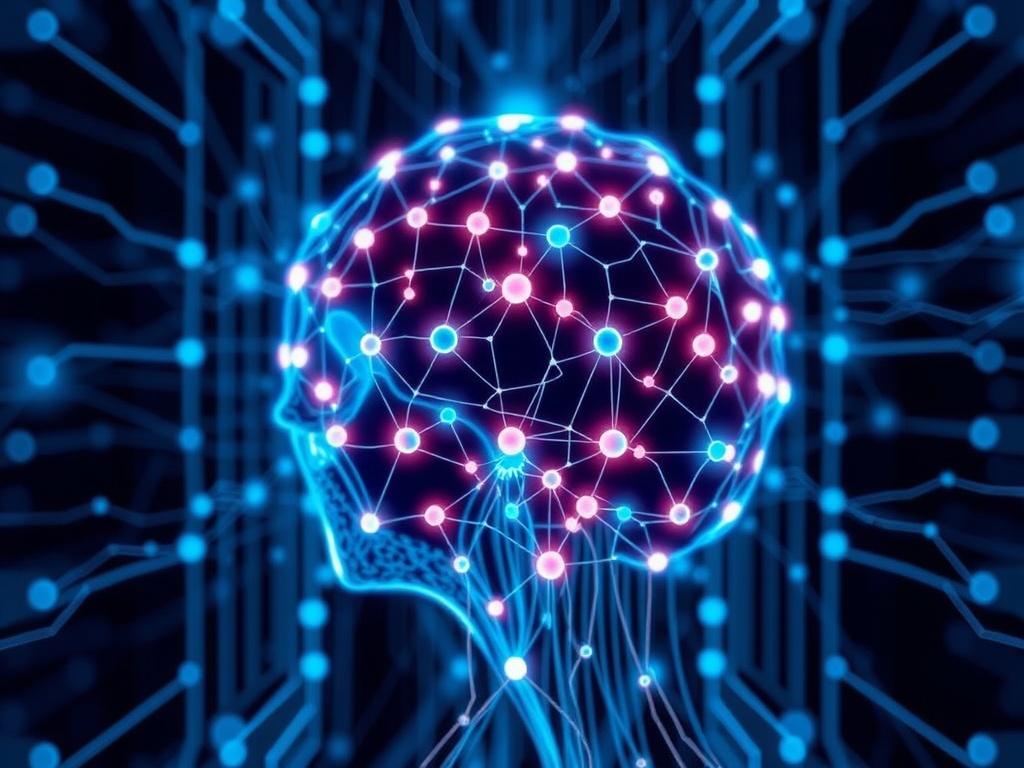
When people talk about artificial intelligence today, much of the conversation pivots around neural networks and the feats they make possible: fluent translation, convincing images, and assistants that anticipate questions. At root, neural networks are mathematical structures inspired by the brain, but they have their own rules and quirks that make modern AI behave in surprising ways. This article explores how neural networks power modern artificial intelligence, tracing their building blocks, training, architectures, and practical limits.
From simple units to layered systems
A single artificial neuron is a tiny calculator: it multiplies inputs by weights, sums them, and applies a function to produce an output. Alone, it can model a linear relationship, which is useful but limited; the real power appears when neurons are arranged into layers so that later layers recombine earlier features into progressively richer representations. Depth—many layers stacked—lets networks capture complex patterns such as edges in images, words in sentences, and temporal structure in time series.
Layers introduce hierarchy. Early layers often detect low-level signals while deeper layers assemble those signals into concepts humans recognize, like faces or grammar patterns. That emergence of structure, not explicit rules, is why networks can generalize across tasks they were not hand-coded to solve. Understanding that emergence requires both visual inspection of activations and careful experimentation.
Training: the engine behind capability
Training is the process by which a network adjusts its weights to reduce the difference between its predictions and the truth. Gradient-based optimization, especially backpropagation paired with stochastic gradient descent variants, is the standard approach: the model computes an error, traces that error back through layers, and nudges parameters to improve future outputs. This iterative refinement over large datasets is what converts network architecture into real capability.
Data matters as much as algorithmic machinery. The diversity, quality, and labeling of training data steer what the network learns and what biases it inherits. Regularization techniques—dropout, weight decay, data augmentation—help prevent overfitting, and careful validation protocols guard against accidental optimism about performance on new inputs.
Loss functions, compute, and practical tricks
Choice of loss function defines the model’s objective: cross-entropy for classification, mean squared error for regression, and specialized adversarial losses for generative models. Practitioners also rely on practical tricks like learning-rate schedules, warm restarts, and mixed-precision arithmetic to speed training and stabilize convergence. These details often separate an experimental model from a production-ready system.
Hardware plays an outsized role in modern practice. GPUs and TPUs accelerate the linear algebra at the heart of training, enabling models with millions or billions of parameters to be trained in feasible timeframes. That computational scale transformed neural networks from academic curiosities into engines that power real-world products.
Architectures that advanced the field
Different tasks favor different architectures. Convolutional neural networks excel at spatially structured data like images, recurrent networks and their successors capture sequence dependencies, and the Transformer family has revolutionized language and multimodal processing. Each design encodes inductive biases that make learning efficient for specific problem classes.
| Architecture | Core idea | Common uses |
|---|---|---|
| Feedforward / MLP | Layered nonlinear mappings | Tabular data, baseline models |
| Convolutional (CNN) | Local receptive fields and weight sharing | Image recognition, video, medical imaging |
| Recurrent / LSTM | Stateful processing of sequences | Speech, time series, older NLP |
| Transformer | Attention across sequence positions | Language models, multimodal AI |
Real-world applications and a practitioner’s view
Neural networks are now embedded in products we use daily: personalized recommendations, voice assistants, spam filters, and image search all rely on learned representations rather than hard-coded rules. In my own work building a document search tool, switching from keyword heuristics to a small transformer model reduced user search time by nearly half and recovered relevant results that simple matching missed. That practical improvement came from the model’s ability to understand intent rather than exact phrasing.
Application success often follows a cycle: prototype with an off-the-shelf model, evaluate on domain data, then fine-tune and integrate. This process reveals gaps—data drift, edge cases, or latency constraints—that shape system design. Thoughtful deployment, monitoring, and retraining keep models aligned with changing realities.
Limitations, risks, and ongoing research
Neural networks are powerful but fallible. They can be brittle under distribution shifts, opaque in reasoning, and resource-hungry to train and run. Adversarial examples demonstrate that tiny input perturbations can cause catastrophic errors, which matters for safety-critical systems. Awareness of these risks has led to research in interpretability, robust training, and model compression.
Ethical and societal concerns are also central: biased training data produces biased outcomes, and opaque decision-making complicates accountability. Addressing these issues requires cross-disciplinary effort—technical fixes, policy frameworks, and continuous auditing. The field is moving toward more transparent models and tools that help practitioners detect and mitigate harm.
Neural networks are not magic; they are tools whose behavior depends on design choices, data, and careful stewardship. When applied thoughtfully, they unlock new capabilities and efficiencies; when applied carelessly, they amplify errors and inequities. Understanding their mechanics—how they learn, what shapes their representations, and where they break—is the best way to harness their power responsibly and creatively.